It's a curious thing to me to see so many people ask about how to break into the industry. I may not be a well known name in the industry, but I have my foot in the door and there are some great bits of truth I have discovered in my short journey (mind you I've only being serious about digital illustration since February of this year). Despite my short time in this field, I've suddenly found a pouring of illustration offers coming my way. I am ecstatic. I wish I could post what I have been working on, but know that I have been working hard.
One thing I have found to be true from all of this is that people take your art as seriously as you do. I first came upon this phrase while reading an article on the five fears that can destroy an artist. First and foremost, a serious artist spends some serious time working on art but that alone will not get you work. After building my portfolio, I realized I needed a professional web presence to be competitive. Soon after creating my art website, revitalizing this art blog, and posting on conceptart.org I found illustration offers pouring in. I couldn't believe it. What I gather from this, is that by creating a professional space to showcase my work and declaring myself an illustrator boldly on my homepage (granted I had only done a few personal commission at that point but you have to start somewhere), I showed people that I believed in myself. I also let my family and friends know what I was up to. I wasn't just doing art as a hobby anymore. I was serious about it and working hard. It was an attitude adjustment and people can tell that I have changed. I used to be embarrassed to let my friends see my work. Not anymore. It is what it is and it was time to own up.
That isn't always enough. The next step was getting my website seen. That's where my deviantart account and posting on art forums came in handy. I wrote a journal to let my watchers on deviantart know where to find my work online, but what really has helped me branch and network has been the simple and yet powerful act of posting critics and offering insight on conceptart.org. People were curious about this person they had never heard about. I've always been of the mindset that you have to give a little to get a little. Helping others and cheering at others accomplishments is a win win. By commenting on other people's blogs and taking part in online discussions you become visible. You aren't going to get much traffic by getting your website up and twiddling your thumbs. And you never know who is going to be a good referral. Networking is very important when it comes to this industry. Another great way to get your work seen is to take part in challenges and contests. My work is in the current ImagineFX magazine again for winning the monthly challenge and this time my new website will be printed beside my work. With so many people scouting for new talent such a thing could only help, not hurt.
Now there are even better ways to get your name out there. Putting yourself on networks like elance.com or cloroflot are great ways to get your work shown to potential clients right away. Setting up tables at conventions and meeting people in the industry is also a great way to get your name out there, or so I hear. I want to do this soon, but I simply don't have enough work to sell at this point. It is something I hope to do in the near future however.
So to sum things up, how do you break into the industry? First, make good art, second, create a visible web presence, and third, network. So get out there and make it happen!
Do you have any tips on how to break into the industry?
Sunday, August 21, 2011

Thursday, July 28, 2011
Ah sweet internet, it's so good to see you again!
Ever get cut off from the internet and feel absolutely lost? My internet was down all day yesterday and while the frustration was eating away at me I was able to hunker down and do some drawing and my productivity was much better. Makes me want to sign up for that selfcontrol app I heard about but sadly it is only for Macs. For now I'll have to try out a similar extension for Firefox called leachblock. Distractions are dangerous and I am guilty of surfing news sites when I should be drawing.
With a lot of commissions pouring in at this time (yay), I really want to up my productivity and the speed at which I work so that I can get more art in every single day. I was supposed to get up this morning at 5:30am and get to drawing, but after the hubby woke me on his way out the door for work I soon fell asleep again. Drats! I didn't used to try and get up at ungodly hours of the morning. It wasn't until I read this mind altering article on the differences between professional artists and amateaur artists that I decided it was time to make a change. Still, it hasn't been easy being a stay at home mother to two very young children and get art in, but if Brad Rigney can be a stay at home dad and do work for top clients like Massive Black then I can find a way!
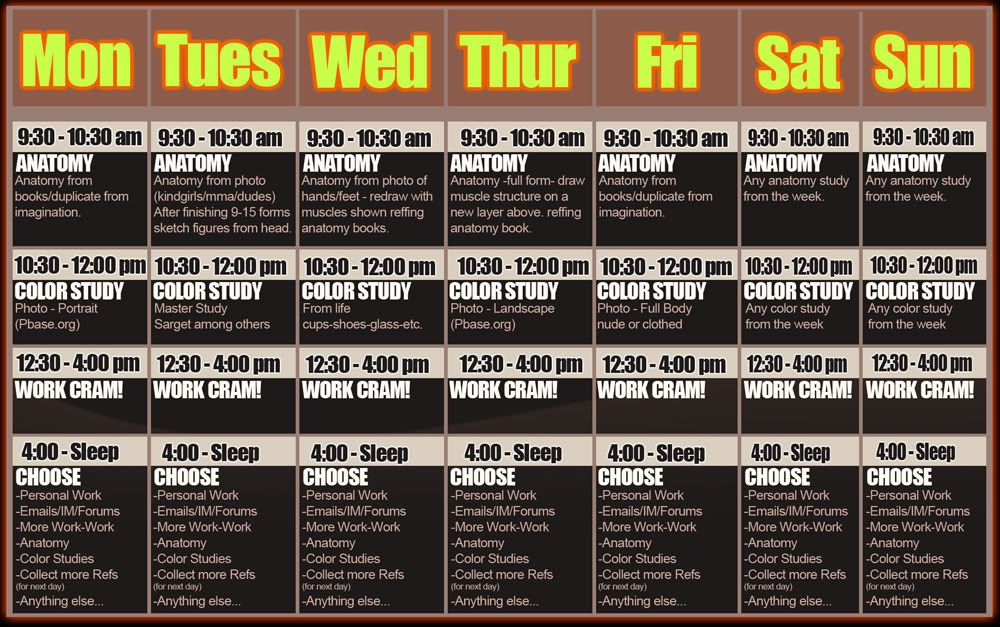
Maybe I need to create a crazy schedule like this guy. What I like most about it, is that he always puts time in for studies to keep learning every day. That is something I yet to do- once I start on a commission it is usually my only project until it is completed. But by following a schedule like this I might be able to work a couple of projects at once AND still get in some practice speed paintings.
My next problem is speed. I want to be able to make a decent income doing this but I can't get in enough projects in a month to make it work yet. I know that part of it comes down to how much I charge for my services, and with time that rate will increase. Until then, I need to draw draw draw and push myself to get past working on details at an early stage.
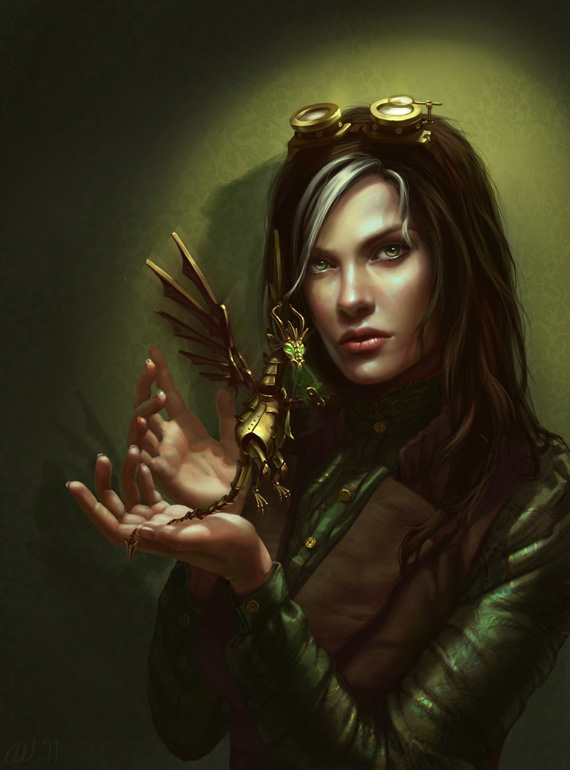
 My last steampunk piece is a great example of how NOT to do a piece. I started out planning to make a very soft elven maiden drawing for Exotique 7's call for entries. I soon realized that I can't do uber soft like Melanie Delon and it was time to do my own take. Problem is, it took me nearly 20 hours to get to that point and I had only worked on the face. Then I decided to take it in another direction and spent countless other hours trying to fix artistic problems that should have been solved early on in the thinking process. All in all, the piece took entirely too long. During that time I could have been working on another concept portfolio piece (these pretty characters are fun to do, but they aren't your typical commercial type of art). Sometimes it's best just to move on and get to the next project like . Oh well, lesson learned.
I'll be creating my own schedule here soon and try to stick to it! So how do you balance art and life?
With a lot of commissions pouring in at this time (yay), I really want to up my productivity and the speed at which I work so that I can get more art in every single day. I was supposed to get up this morning at 5:30am and get to drawing, but after the hubby woke me on his way out the door for work I soon fell asleep again. Drats! I didn't used to try and get up at ungodly hours of the morning. It wasn't until I read this mind altering article on the differences between professional artists and amateaur artists that I decided it was time to make a change. Still, it hasn't been easy being a stay at home mother to two very young children and get art in, but if Brad Rigney can be a stay at home dad and do work for top clients like Massive Black then I can find a way!
Maybe I need to create a crazy schedule like this guy. What I like most about it, is that he always puts time in for studies to keep learning every day. That is something I yet to do- once I start on a commission it is usually my only project until it is completed. But by following a schedule like this I might be able to work a couple of projects at once AND still get in some practice speed paintings.
My next problem is speed. I want to be able to make a decent income doing this but I can't get in enough projects in a month to make it work yet. I know that part of it comes down to how much I charge for my services, and with time that rate will increase. Until then, I need to draw draw draw and push myself to get past working on details at an early stage.
I'll be creating my own schedule here soon and try to stick to it! So how do you balance art and life?
Sunday, July 17, 2011
The sincerest form of flattery perhaps? Copying vs Reference
As many of you probably know, there is a well known fantasy artist who recently was accused of pasting elements of several other peers works into her own and painting over them. This artist has since sold these images in her books. Now this news did interest me as I was a fan of her work, but it interests me even more as one of the artists she is now accused of stealing from. Whether her affirmation that she hand painted everything is true or not, it did get me thinking that perhaps this is a great time for healthy discussion about the use of "reference".
Now there is a large divide in the world of art. Those who happily use reference images they find online and those that shun the practice. In case you wondering, I put myself in the "happily uses online ref" category. Let me explain why.
I define reference as some sort of imagery, whether perceived naturally or through photos/videos, which is used to help draw/paint/sculpt a new piece of art. Referring could mean a quick glance to establish a similar mood, color combinations, or to brush up on creature anatomy, or it could be in depth copying with methods such as "gridding" where the image looked upon is copied almost exactly. (Tracing is a different method and involves copying and pasting, projecting, and painting over other imagery and is another discussion altogether).
Now the debate isn't so much about either method, but whether or not the person using said imagery happens to have permission to use copyrighted images for reference or tracing/painting over. The answer may surprise you. Under most copyright laws in the world, as long as the imagery created is a "derivative" work and not a copy, it can be used as reference but copying and pasting someone's work into your own without permission is a much more dangerous practice. However it is important to mention that what is allowed under law is not necessarily looked upon with acceptance in prominent art communities.
Now I had a professor in college who does commercial art for clients based in California including Disney and other big name movies. As someone in the field, he explained to us that art directors don't care if you don't know how to draw a turtle from memory or not, if you have a project due at the end of the week you had better have an anatomically correct rendering of a turtle. Say there are no turtles around- you had better humble yourself and find some online reference. So how do you use online reference and still feel good about yourself at the end of the day? I find the key element to all of this, is to what extent you refer to something.
Referring to me, means looking at something, learning from it, and making something new. It means creating something similar with different angles and perspective, lighting, or mood. It's okay to look at online reference, and even other artwork. For example, below I have two images, one a reference image I used to create the other.
Character by ~akizhao on deviantART
Elven Concept by `lithriel on deviantART
Now if you look the images are almost identical in mood and color combinations but they are entirely different in every other way. This type of referring is usually called inspiration but it is reference all the same.
The best way to use exact reference, as my professor explained, is to build up your own library of stock photos, or buy them online if you must refer to something directly. No amount of reasoning can save your hind end should you use something copyrighted and get your publisher sued.
Now there are some times when copying directly can be a good thing, like when doing master studies. However studies are used for learning and not for making money. Even fan art, which I have done my fare share of in the past, can be a fun release provided you give credit where credit is due and don't profit off of your work.
So where do you draw the line with reference?
Now there is a large divide in the world of art. Those who happily use reference images they find online and those that shun the practice. In case you wondering, I put myself in the "happily uses online ref" category. Let me explain why.
I define reference as some sort of imagery, whether perceived naturally or through photos/videos, which is used to help draw/paint/sculpt a new piece of art. Referring could mean a quick glance to establish a similar mood, color combinations, or to brush up on creature anatomy, or it could be in depth copying with methods such as "gridding" where the image looked upon is copied almost exactly. (Tracing is a different method and involves copying and pasting, projecting, and painting over other imagery and is another discussion altogether).
Now the debate isn't so much about either method, but whether or not the person using said imagery happens to have permission to use copyrighted images for reference or tracing/painting over. The answer may surprise you. Under most copyright laws in the world, as long as the imagery created is a "derivative" work and not a copy, it can be used as reference but copying and pasting someone's work into your own without permission is a much more dangerous practice. However it is important to mention that what is allowed under law is not necessarily looked upon with acceptance in prominent art communities.
Now I had a professor in college who does commercial art for clients based in California including Disney and other big name movies. As someone in the field, he explained to us that art directors don't care if you don't know how to draw a turtle from memory or not, if you have a project due at the end of the week you had better have an anatomically correct rendering of a turtle. Say there are no turtles around- you had better humble yourself and find some online reference. So how do you use online reference and still feel good about yourself at the end of the day? I find the key element to all of this, is to what extent you refer to something.
Referring to me, means looking at something, learning from it, and making something new. It means creating something similar with different angles and perspective, lighting, or mood. It's okay to look at online reference, and even other artwork. For example, below I have two images, one a reference image I used to create the other.
Character by ~akizhao on deviantART
Elven Concept by `lithriel on deviantART
Now if you look the images are almost identical in mood and color combinations but they are entirely different in every other way. This type of referring is usually called inspiration but it is reference all the same.
The best way to use exact reference, as my professor explained, is to build up your own library of stock photos, or buy them online if you must refer to something directly. No amount of reasoning can save your hind end should you use something copyrighted and get your publisher sued.
Now there are some times when copying directly can be a good thing, like when doing master studies. However studies are used for learning and not for making money. Even fan art, which I have done my fare share of in the past, can be a fun release provided you give credit where credit is due and don't profit off of your work.
So where do you draw the line with reference?
Thursday, June 9, 2011
Simplification and it's grand rewards

Greetings all! Guess what? I won the ImagineFX challenge again this month! :D Now I think it's time to step aside and give it a rest. I might still do the challenges but I won't post them in the finals. Here's the final winning image (but you can give me some crit over at conceptart.org).
It's nicely rendered, but I'd really like to loosen up my style. I think if I had a more defined style I would be a lot further along in getting into the industry. As it is, I border on being forgettable. Looking around some art sites, I've been greatly inspired by works like this:
FAFN forest defenders by ~Pervandr on deviantART
And this guy who blows me away- http://www.ruanjia.com/
I love how each stroke defines the form and yet doesn't over define it. It reminds me of the very powerful statement I read recently in a great art tutorial-
"The advantage art holds over photos is simplification. In a photo you'll get distracting details. When drawing, you can remove objects that aren't relevant to the scene. "
Each and every stroke should add something to the piece. If it's not needed, you shouldn't add it. That is a substantial thought. It really made me think. Hope it makes you think too. ;)
And here are a few quick sketches I've done in the past week trying to loosen up.


Ref- link
I still have a ways to go as you can see but I am trying.
During my studies this week I have discovered a way to replicate that really nice hard brush look I see in concept art. My hard round brush just wasn't doing the trick. So played around and discovered that the "oil heavy flow dry edges" brush set with low opacity and low flow gets close to the effect. Anyone else have a different technique? I used it for the tornado speed paint above. Here are my settings:

And as stated I have joined some more art communities. Leave me a message and we can hook up:
http://lithriel.cghub.com/
http://conceptart.org/forums/member.php?u=314321
http://lithriel.cgsociety.org/
Thursday, June 2, 2011
A Word on Eye Level
Many times in illustration we need to draw several subjects and objects in one scene. One mistake I have seen even the pros make is having multiple eye levels in one piece. What’s the big deal, you say? Well if your entire scene has the same perspective then eye level should be the same across the entire piece. There should only be one eye level.

What does eye level even mean? Eye level is the point at which you, the audience, is viewing something straight ahead. So if you were looking at a telephone pole at just 2 feet away you would have to look down to see the bottom of the pole and up to see the top but if you looked directly ahead you would see the middle of it.
How does that translate into the art world? If you are drawing a medieval dwarf up close at typical eye level (most people are about 5 to 6 feet tall) you would need to draw him as if the audience were looking down on his head. If you were drawing a tall monster terrorizing that same dwarf at close range, your eye level would hit maybe at the monster’s knees and you would be looking up at said monster’s chin. The problem occurs when you are looking down on both the monster and the dwarf because that’s not possible unless you as the audience is viewing the scene up in the sky, get me? You need to draw the monster in perspective in relation to the perspective already established in the rest of the scene.


Another time I see a problem is when I am looking at say, an illustration of a group of really cool people all standing behind the hero in an awesome v formation (because in the hero world everybody stands like this naturally). The illustration is looking so awesome, until I look at their feet. What’s wrong, you ask? I’m seeing everyone’s head at eye level and their feet too. You can’t do that remember? One eye level only please. I only have one set of eyes and they happen to be right next to each other not at my feet too.

In the case of looking at feet at eye level the bottom of the feet would be straight across. But if I am already looking at their heads at eye level, the feet should not be straight across. It’s either/or not both. If their feet are straight across then we need to be looking up at their heads.
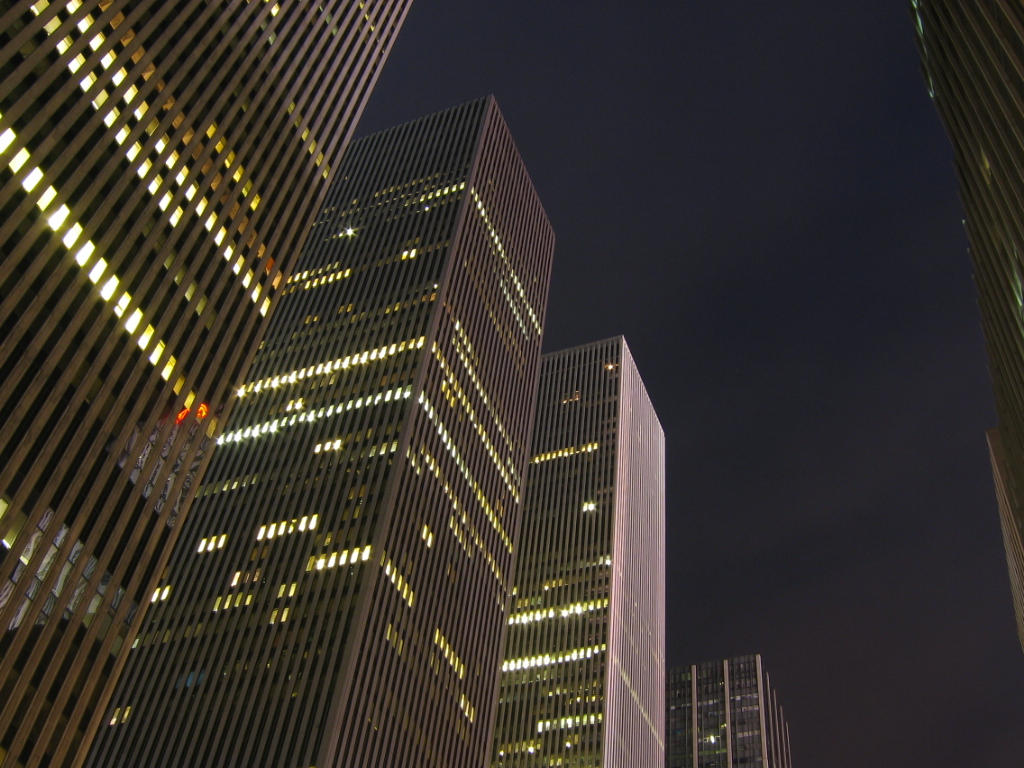
Think of it like taking a picture of really tall buildings from ground level.
See that crazy perspective? Figures are the same way when you are looking up from feet level.
The effect is reduced the further you stand back. If you were looking at the tallest man in the world face to chest, the effects of perspective looking up would be drastic whereas if you were looking at him from 50 feet away, it would be more subtle. If you happen to be looking at him from miles away and from up on top of a hill, you would actually be looking down on him because the eye level is the horizon.
Another quick word about ellipses. Just FYI- they follow perspective too. Go get yourself a cup, yes really, go grab one. It will help you understand this principle.
Now hold it right in front of your eyes. You should be seeing the cup straight across. Now hold it at elbow level and closely watch the shape of the opening. It goes from a straight line and morphs into an ellipse. Now set the cup at your feet. The shape of the opening is now a full circle. Now pick up the cup and hold it above your head. Look at the shapes of the ellipses. You can’t see the opening anymore. Remember that as you illustrate. All too often I see the tops of cups I shouldn’t see the tops to. Any cylindrical object above eye level you won’t see the top to unless it is tilted forward. And notice how the ellipses are wider the more you look down. Most people draw them in reverse. They draw the top of the bottle sitting on a table with a nice wide ellipse and the bottom nearly straight across. This is wrong.

Let’s recap.
There is only one eye level.
If you have already established eye level with one figure, the other figures in the scene need to be in perspective relative to what you have already established.
Feet should never be straight across unless you are looking at feet level
The eye level is the horizon.
You can’t see the tops to cylindrical objects above eye level unless they are tilted.
Ellipses get wider the further you get from eye level.
Yes, you can break the rules. Just make sure you know you are breaking them and break them on purpose. Happy illustrating!
Ashley

What does eye level even mean? Eye level is the point at which you, the audience, is viewing something straight ahead. So if you were looking at a telephone pole at just 2 feet away you would have to look down to see the bottom of the pole and up to see the top but if you looked directly ahead you would see the middle of it.
How does that translate into the art world? If you are drawing a medieval dwarf up close at typical eye level (most people are about 5 to 6 feet tall) you would need to draw him as if the audience were looking down on his head. If you were drawing a tall monster terrorizing that same dwarf at close range, your eye level would hit maybe at the monster’s knees and you would be looking up at said monster’s chin. The problem occurs when you are looking down on both the monster and the dwarf because that’s not possible unless you as the audience is viewing the scene up in the sky, get me? You need to draw the monster in perspective in relation to the perspective already established in the rest of the scene.


Another time I see a problem is when I am looking at say, an illustration of a group of really cool people all standing behind the hero in an awesome v formation (because in the hero world everybody stands like this naturally). The illustration is looking so awesome, until I look at their feet. What’s wrong, you ask? I’m seeing everyone’s head at eye level and their feet too. You can’t do that remember? One eye level only please. I only have one set of eyes and they happen to be right next to each other not at my feet too.

In the case of looking at feet at eye level the bottom of the feet would be straight across. But if I am already looking at their heads at eye level, the feet should not be straight across. It’s either/or not both. If their feet are straight across then we need to be looking up at their heads.
Think of it like taking a picture of really tall buildings from ground level.
See that crazy perspective? Figures are the same way when you are looking up from feet level.

The effect is reduced the further you stand back. If you were looking at the tallest man in the world face to chest, the effects of perspective looking up would be drastic whereas if you were looking at him from 50 feet away, it would be more subtle. If you happen to be looking at him from miles away and from up on top of a hill, you would actually be looking down on him because the eye level is the horizon.
Another quick word about ellipses. Just FYI- they follow perspective too. Go get yourself a cup, yes really, go grab one. It will help you understand this principle.
Now hold it right in front of your eyes. You should be seeing the cup straight across. Now hold it at elbow level and closely watch the shape of the opening. It goes from a straight line and morphs into an ellipse. Now set the cup at your feet. The shape of the opening is now a full circle. Now pick up the cup and hold it above your head. Look at the shapes of the ellipses. You can’t see the opening anymore. Remember that as you illustrate. All too often I see the tops of cups I shouldn’t see the tops to. Any cylindrical object above eye level you won’t see the top to unless it is tilted forward. And notice how the ellipses are wider the more you look down. Most people draw them in reverse. They draw the top of the bottle sitting on a table with a nice wide ellipse and the bottom nearly straight across. This is wrong.

Let’s recap.
There is only one eye level.
If you have already established eye level with one figure, the other figures in the scene need to be in perspective relative to what you have already established.
Feet should never be straight across unless you are looking at feet level
The eye level is the horizon.
You can’t see the tops to cylindrical objects above eye level unless they are tilted.
Ellipses get wider the further you get from eye level.
Yes, you can break the rules. Just make sure you know you are breaking them and break them on purpose. Happy illustrating!
Ashley
Wednesday, May 25, 2011
Evolution of an Artist- the advice of Daarken AKA Mike Lim
Ever feel like your art isn't good enough? We've all been there. I'm there right now at this very moment, but there is light at the end of the tunnel. Digital Illustrator Mike Lim shares his long journey as an artist with us in his recent blog post, Evolution of an artist.
He talks about his ever changing art- from his humble beginnings to his latest and greatest work. Along the way he gives fantastic advice about how to keep pushing yourself, and even offers a few well kept secrets about breaking into the industry:
"The reason I was able to get work without having to go out and find it for myself was because I had a very strong online presence" Mikes states. "I posted on many different art forums, I had a website, a blog, and I made a lot of friends and contacts in the industry."
I have always believed that having an artistic network of friends is vital not only for the sake of your career, but for the sake of inspiration, motivation, and critic which helps to push you forward. These things may seem small but as Mike has demonstrated the payoffs can be huge. So if you are new to the art game I suggest joining all the biggest art communities:
The Art Order
Conceptart.org
CGhub.com
ImagineFX
Deviantart
Participate in the challenges, give critic to others, and accept critic with an open mind. This has helped to bring me to the level I am at currently, but I have a long way to go still. Just to give you an idea of my own progression, here is my first digital painting in August of 2009 (which I am totally embarrassed to even show), and here is my current work in progress:


The biggest difference I have seen from then to now is my transition from painting "typical pretty girls" to a more storytelling approach. This is a marked improvement because I have gone from a very reference heavy approach to a "make it up from your mind" take.
But remember how I started this post about saying how I don't think my work is quite where I want it to be? Give me three years and I know I could blow your socks off. Even in three years I will feel the same because there is always room for improvement.
Like Mike Lim states,"never give up... If being an artist is something you truly want to do, be prepared to put everything else aside in order to achieve that dream." And that ladies and gents is why I have been crawling into bed at midnight and getting up first thing in the morning to get in as much art as I can. I am committed for the long run. And if you are too, then get out that tablet and get drawing. That is the best advice anyone can give you.
He talks about his ever changing art- from his humble beginnings to his latest and greatest work. Along the way he gives fantastic advice about how to keep pushing yourself, and even offers a few well kept secrets about breaking into the industry:
"The reason I was able to get work without having to go out and find it for myself was because I had a very strong online presence" Mikes states. "I posted on many different art forums, I had a website, a blog, and I made a lot of friends and contacts in the industry."
I have always believed that having an artistic network of friends is vital not only for the sake of your career, but for the sake of inspiration, motivation, and critic which helps to push you forward. These things may seem small but as Mike has demonstrated the payoffs can be huge. So if you are new to the art game I suggest joining all the biggest art communities:
The Art Order
Conceptart.org
CGhub.com
ImagineFX
Deviantart
Participate in the challenges, give critic to others, and accept critic with an open mind. This has helped to bring me to the level I am at currently, but I have a long way to go still. Just to give you an idea of my own progression, here is my first digital painting in August of 2009 (which I am totally embarrassed to even show), and here is my current work in progress:


The biggest difference I have seen from then to now is my transition from painting "typical pretty girls" to a more storytelling approach. This is a marked improvement because I have gone from a very reference heavy approach to a "make it up from your mind" take.
But remember how I started this post about saying how I don't think my work is quite where I want it to be? Give me three years and I know I could blow your socks off. Even in three years I will feel the same because there is always room for improvement.
Like Mike Lim states,"never give up... If being an artist is something you truly want to do, be prepared to put everything else aside in order to achieve that dream." And that ladies and gents is why I have been crawling into bed at midnight and getting up first thing in the morning to get in as much art as I can. I am committed for the long run. And if you are too, then get out that tablet and get drawing. That is the best advice anyone can give you.
Wednesday, May 11, 2011
Another Win Another DD
Surely one of these days someone is going to say something about how many DD's (daily deviation features) I've accrued. I'm up to 4 already as of today and it won't be long before people have had enough of me, I'm sure! =p My failed FEZ contest entry held by Deviant Art was chosen for the honor today and while I am quite proud at my contrast work with this piece it has several flaws. It didn't even make into the semi-finalists.

I wish they had just waited a little longer because I was seriously thinking about revamping this piece for my portfolio. There is such nice contrast and lighting going on and it's one of my most successful thumbnails or "reads well from a distance" pieces. Again I owe a shout out to the guys over at FZD School of Design for their amazing tutorials which frequently go over this very concept. However it's very low resolution, and I desperately want to rework some areas that I just ran out of time to address.
And would you believe it? I also won the April Monthly challenge over at ImagineFX? That means I will most likely be published again which is way way cool. :D At the same time though, my current monthly challenge (which I had the honor of choosing), has a much more complex and epic entry in progress which I feel merits publishing over last month's entry hands down. Here's a sneak peak:


I wish they had just waited a little longer because I was seriously thinking about revamping this piece for my portfolio. There is such nice contrast and lighting going on and it's one of my most successful thumbnails or "reads well from a distance" pieces. Again I owe a shout out to the guys over at FZD School of Design for their amazing tutorials which frequently go over this very concept. However it's very low resolution, and I desperately want to rework some areas that I just ran out of time to address.
And would you believe it? I also won the April Monthly challenge over at ImagineFX? That means I will most likely be published again which is way way cool. :D At the same time though, my current monthly challenge (which I had the honor of choosing), has a much more complex and epic entry in progress which I feel merits publishing over last month's entry hands down. Here's a sneak peak:

Subscribe to:
Posts (Atom)